
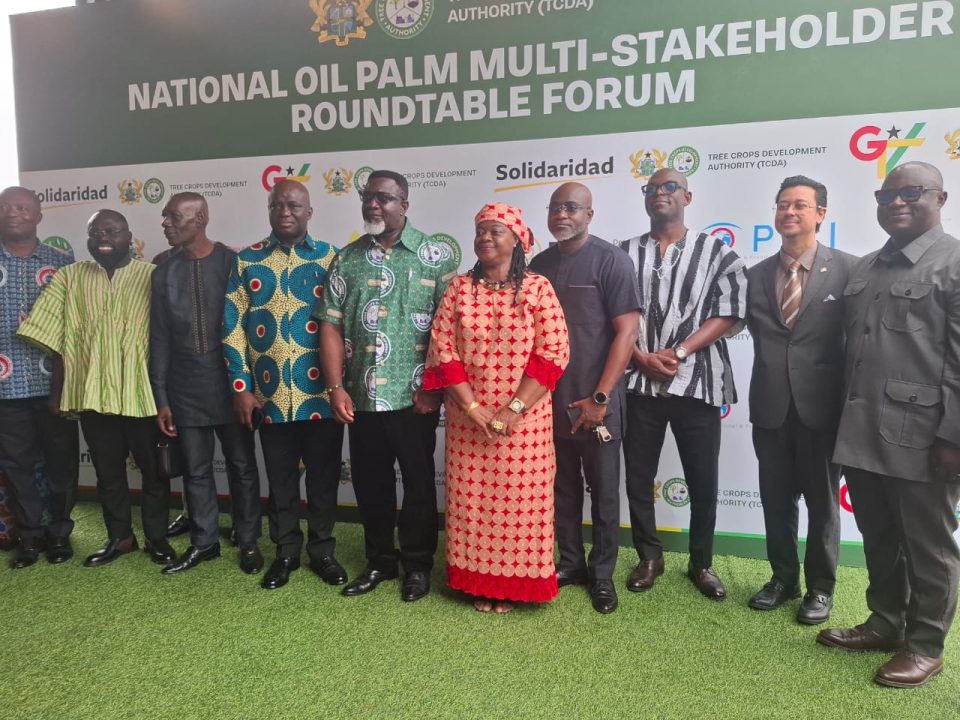
The Tree Crops Development Authority (TCDA) has been mandated to lead Ghana’s drive to expand oil palm production, as the government targets 100,000 new hectares in 2026, with a strong focus on sustainability, inclusion, and value addition.
Speaking at a national multi-stakeholder roundtable, the Chief Executive Officer of TCDA, Dr. Andy Osei Okrah, said the expansion must avoid deforestation and instead prioritise suitable production zones, rehabilitation of aging farms, and closing yield gaps on existing plantations.
“Ghana must prove that agricultural expansion and environmental responsibility can advance together,” a speaker stated.
TCDA Named Institutional Anchor
Established under the Tree Crops Development Authority Act, 2019 (Act 1010), TCDA is expected to serve as the anchor for registration, licensing, production planning, industry data, traceability, and quality assurance across the value chain.
“For this national initiative, TCDA must serve as the institutional anchor and ensure orderly development across the value chain,” officials said.
Formalisation and Market Access
The government stressed that competitiveness requires formalisation. Every nursery operator, farmer, aggregator, processor, trader, and exporter must register and comply.
“Registration, licensing, and compliance are not administrative burdens. They are the foundations of credibility, investor confidence, traceability, and access to premium markets,” the speaker noted.
TCDA will be supported to enforce standards fairly and discourage illegal trade.
No Single Institution Can Deliver
While the Ministry of Food and Agriculture will provide policy leadership, officials said implementation will require TCDA, research institutions, financial institutions, development partners, district assemblies, traditional authorities, farmer organisations, and the private sector.
“No single institution can deliver this transformation,” he said.
Women, Youth and Smallholders at the Centre
Stakeholders emphasised deliberate opportunities for women and young people in production, aggregation, processing, technology, logistics, and enterprise.
“An industry that excludes them cannot be transformed,” he noted.
Smallholders must also be placed at the centre, with secure markets, transparent pricing, extension support, and a fair share of the value. Large-scale investments must grow alongside organised outgrower schemes.
Land, Finance and Processing
The third priority is resolving land and financing constraints. Oil palm requires secure tenure and patient capital that matches its gestation period.
Banks must develop fit-for-purpose products, while traditional authorities ensure transparent land arrangements.
Production must also be matched with efficient mills, storage, logistics, and deeper value addition.
“We must reduce post-harvest losses and improve extraction rates. Ghana should aspire to manufacture more finished products consumed at home and exported,” he said.
Markets are demanding proof of origin, environmental responsibility, decent labour practices, and quality.
“Exclusion is therefore no longer an option,” the speaker said. The industry must become traceable and sustainable to compete globally.
From Policy to Measurable Action
Officials urged the forum to agree on practical next steps, responsible institutions, timelines, and monitoring.
“When we meet again, progress must be visible, not merely in reports, but in certified nurseries, productive farms, functioning mills, new businesses, decent jobs, increased local supply, and reduced imports,” he said.
A National Resolve
Ghana, participants noted, has the land, climate, knowledge, and market to become a leading producer of sustainable palm oil.
“Ghana will not remain a nation of enormous agricultural potential and limited agricultural results. We will cultivate that potential, process it, add value to it, and transform it into prosperity,” the speaker declared.
He commended TCDA, farmers, processors, investors, and all stakeholders for their role in moving the agenda forward.
