
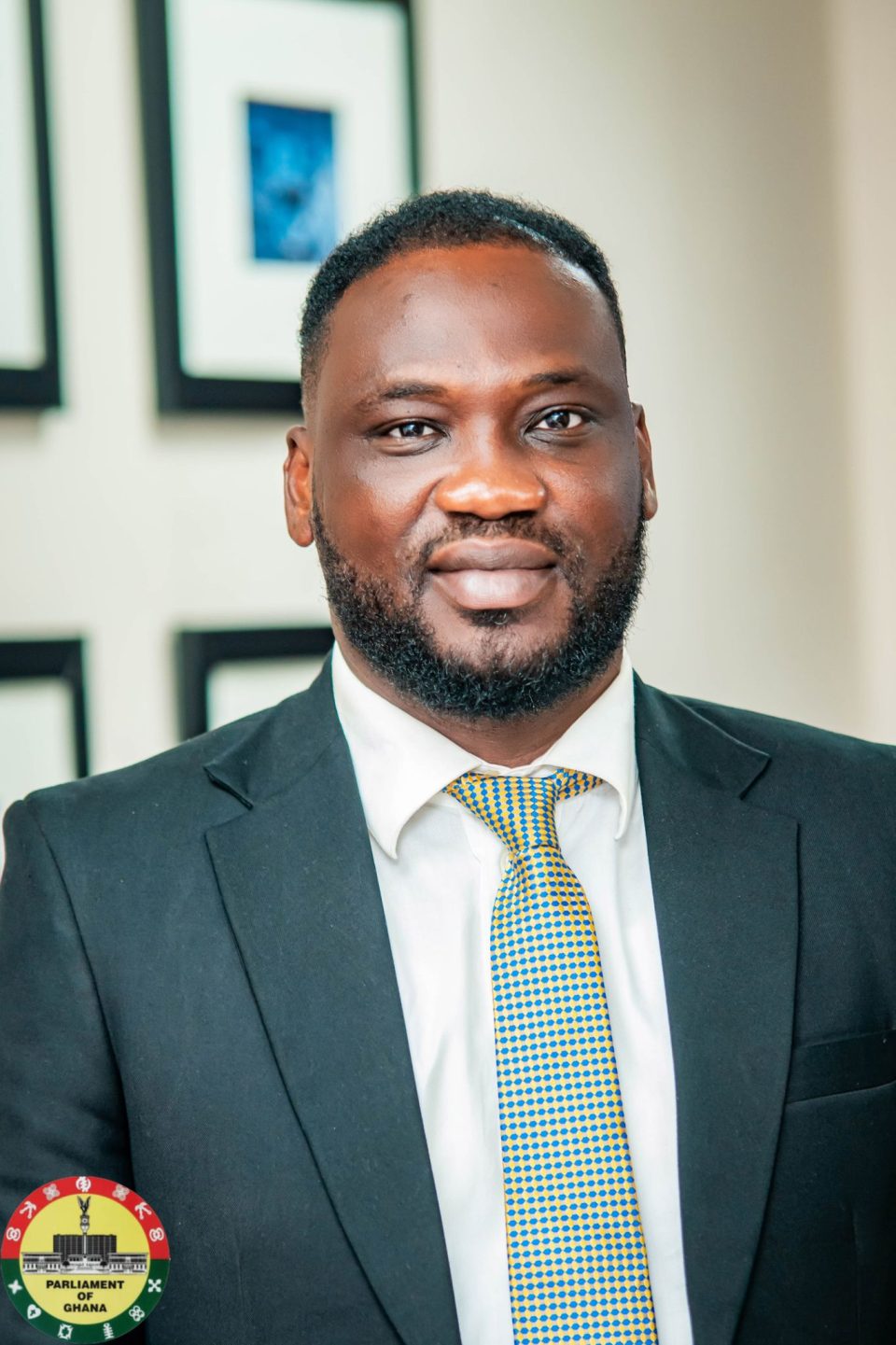
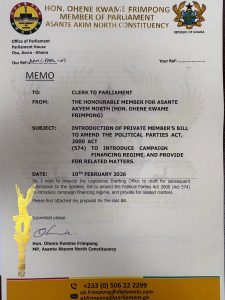
Accra, 10th February 2026 – The Member of Parliament for Asante Akim North, Hon. Ohene Kwame Frimpong, has introduced a Private Member’s Bill aimed at amending the Political Parties Act, 2000 (Act 574) to introduce a comprehensive campaign financing regime in Ghana.
The move comes amid growing concerns over the rising cost of politics in the country. Since the return of multiparty democracy in 1992, Ghana has held nine general elections, witnessing four peaceful transfers of power. Yet, the financial demands of political campaigns are increasingly seen as a barrier to fair competition.
Currently, the Political Parties Act does not regulate campaign financing. There is no legal framework for limiting campaign expenditures, capping contributions, or mandating detailed disclosure of funds. Campaigns, therefore, rely heavily on informal and opaque sources of financing.
Data from the Ghana Centre for Democratic Development (CDD-Ghana, 2025) show that contesting a presidential election now costs an estimated USD 200 million, while parliamentary campaign costs increased by 59% between 2012 and 2016, according to the STAR-Ghana Foundation. These trends, analysts warn, threaten inclusivity and democratic accountability.
Hon. Frimpong highlighted that escalating campaign costs effectively price out marginalized groups, particularly women and youth. For instance, women held only 15% of parliamentary seats in 2016. He argued that without reform, political participation will continue to favor those with financial clout rather than competence or ideas.
The bill also aims to tackle corruption in politics. Allegations of vote buying and illicit funding during the 2026 NPP Presidential Primaries and the NDC Ayawaso East Parliamentary Primaries are now before the Office of the Special Prosecutor. Lawmakers say that without clear rules on campaign financing, such practices will persist.
International best practices inform the proposed reforms. According to International IDEA and Transparency International, over 180 countries regulate political finance through contribution limits, expenditure caps, public funding, disclosure requirements, and independent oversight. Countries such as Canada, Germany, France, and the UK have used such mechanisms to curb corruption and undue influence.
The Political Parties (Amendment) Bill, 2026, proposes to cap contributions from individuals at GHS 500,000 for presidential and GHS 100,000 for parliamentary campaigns, while campaign spending would be limited to GHS 5 million and GHS 500,000 respectively. Foreign and anonymous donations would be strictly prohibited.
To level the playing field, the bill also establishes a Political Parties Development Fund, administered by the Electoral Commission, which will provide partial public financing. The fund will be allocated based on electoral performance, with mandatory auditing and publication of reports by the Auditor-General.
If passed, the bill is expected to promote transparency, equity, accountability, and integrity in Ghanaian politics. Lawmakers and political analysts alike say it could significantly reduce corruption, encourage greater participation by women and youth, and restore public confidence in the country’s democratic process.
The Member of Parliament for Asante Akim North, Hon. Ohene Kwame Frimpong, has initiated a private member’s bill to amend the Political Parties Act, 2000 (Act 574) to introduce a campaign financing regime and provide for related matters.
It may be recalled that since the reintroduction of multiparty democracy in 1992, Ghana has held nine successful general elections, with four peaceful transfers of power. This democratic progress, however, faces a growing challenge: the rising cost of politics.
The Political Parties Act, 2000 (Act 574) regulates the registration and functioning of political parties but remains silent on campaign financing. As a result, there is no legal framework limiting campaign expenditure, capping contributions, or mandating detailed disclosures. Political campaigns now rely heavily on private, informal, and often opaque sources of funding. The Ghana Centre for Democratic Development (CDD-Ghana, 2025) estimates that the cost of contesting presidential elections has risen to approximately USD 200 million, while the cost of parliamentary campaigns rose by 59% between 2012 and 2016 (STAR-Ghana Foundation, 2018). These trends threaten democratic inclusivity and accountability.
2. Problem Statement
1. Escalating Campaign Costs:
Political competition is increasingly determined by financial strength rather than competence, ideas, or integrity.
2. Exclusion of Marginalized Groups:
Women, youth, and persons of limited means are priced out of meaningful participation in politics. For instance, women held only 15% of parliamentary seats in 2016.
3. Corruption and Vote Buying:
The absence of financial regulation encourages vote buying and illicit funding. Allegations during the 2026 NPP Presidential Primaries Campaign held on 31st January 2026, and the NDC Ayawaso East Parliamentary Primaries contests held on 7th February 2026, now before the Office of the Special Prosecutor, underscore this challenge.
4. Weak Oversight:
The Political Parties Act lacks disclosure, auditing, and sanction mechanisms necessary to ensure financial integrity.
3. Rationale for the Bill
Globally, more than 180 countries regulate political finance to promote transparency and fair competition. According to the International IDEA Political Finance Database (2024) and Transparency International (2023), key best practices include:
Limits on private contributions
Public funding mechanisms to level the playing field
Expenditure caps and disclosure requirements
Independent oversight and enforcement
Countries such as Canada, France, Germany, and the United Kingdom have adopted these principles to curb corruption and reduce undue influence in politics. Ghana’s growing cost of politics makes similar reform both urgent and necessary.
4. Object of the Bill
The object of the Political Parties (Amendment) Bill, 2026 is to:
1. Regulate the sources of campaign funds, ensuring transparency and legality.
2. Establish limits on campaign contributions and expenditures.
3. Create a Political Parties Development Fund to provide partial public financing for parties and candidates.
4. Introduce mandatory financial disclosure and auditing requirements.
5. Strengthen oversight and enforcement mechanisms under the Electoral Commission and the Office of the Special Prosecutor.
This framework seeks to restore fairness, curb corruption, and enhance public confidence in Ghana’s democratic process.
5. Key Provisions of the Bill
Part IV — Regulation of Campaign Financing
Only citizens and Ghanaian-registered entities may contribute
Foreign and anonymous donations prohibited
Individual contributions capped at GHS 500,000 (presidential) and GHS 100,000 (parliamentary)
Campaign expenditure capped at GHS 5 million (presidential) and GHS 500,000 (parliamentary)
Part V — Public Funding and Transparency
Establishment of a Political Parties Development Fund, administered by the Electoral Commission
Funds allocated proportionally to parties based on electoral performance
Annual audit by the Auditor-General and publication of reports
Part VI — Enforcement and Sanctions
Oversight by the Electoral Commission and Office of the Special Prosecutor
Non-compliance attracts administrative sanctions, fines, and disqualification
6. Expected Impact
Transparency: Promote openness in political financing
Equity: Reduce financial barriers for women and youth participation
Accountability: Strengthen enforcement mechanisms and public trust
Integrity: Reduce corruption and monetization of politics.
