
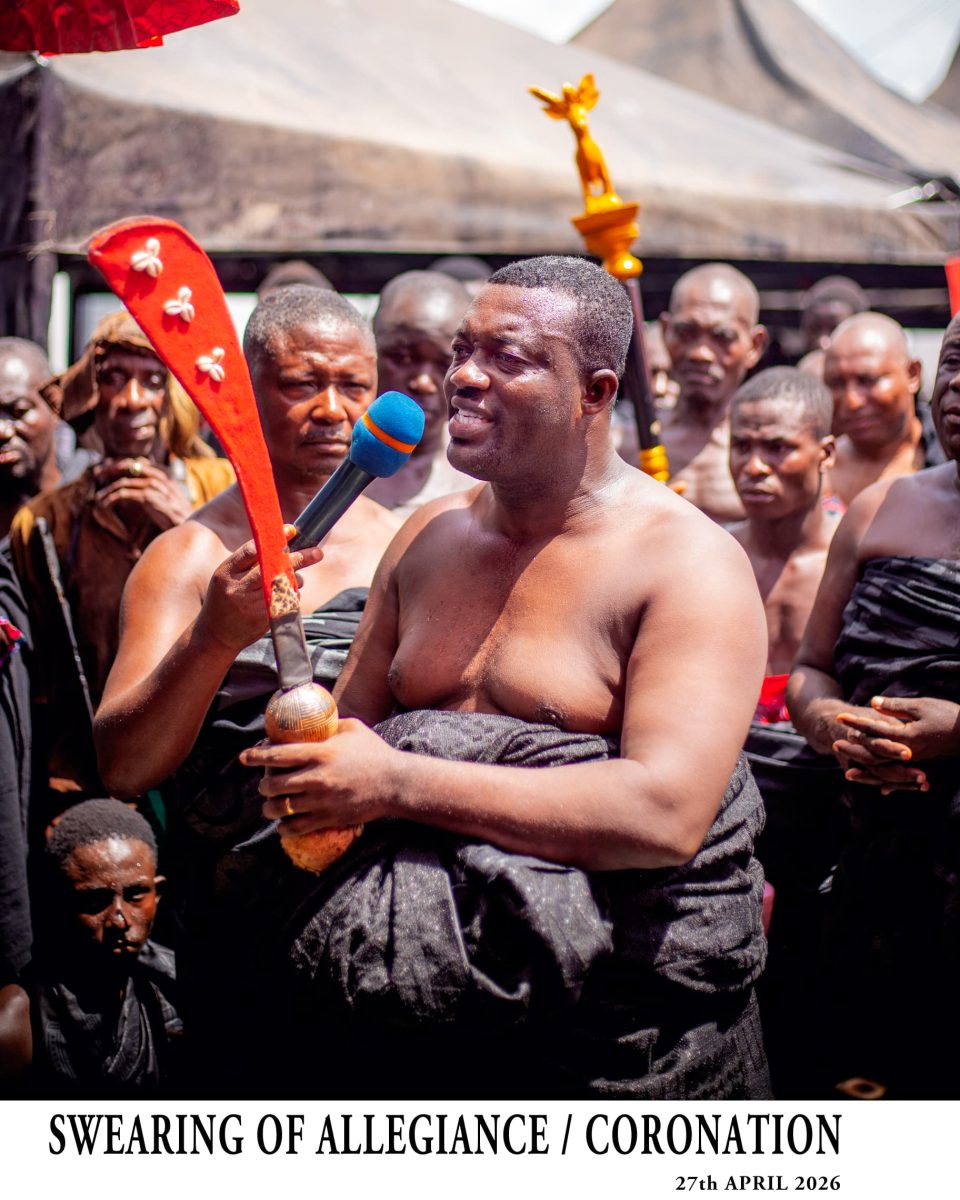
The Denkyira Nsuasehene, Nana Kwaku Adde III, who also doubles as the Denkyira Nseniehene, officially and solemnly swore the sacred oath of allegiance to Odeefuo Boa Amponsem IV on Monday, 27th April 2026, at Amponsem Fie, Nkonwafieso, Jukwa, the traditional capital of the Denkyira Kingdom.
The ceremony attracted several Divisional Chiefs, Sub-divisional Chiefs, Chiefs, Sub-chiefs, political party leaders, MPs, MMDCEs, and senior members of public institutions.
The swearing of the oath of allegiance, using the Denkyira state sword, Dampon (Damenama a Opon Abrempon), reaffirmed Nana Kwaku Adde III’s allegiance, loyalty, dedication, and commitment to Bankamdwa and the authority of the Denkyira Kingdom. The event also showcased the rich cultural heritage, customs, and traditions of the Denkyira State through traditional processions, drumming, and customary observances.
Historical Significance of the Nsenie Stool
The office of the Denkyira Nseniehene occupies an important position in the traditional governance structure and polity of Denkyiraman.
Historical accounts confirm that the Nseniehene stool is one of the oldest stools in Denkyiraman. While the Akyeamehene serves as the chief linguist for the entire Denkyiraman, the Nseniehene is the personal chief linguist of the Denkyirahene.
The stories, myths, and lineages of the Denkyira people existed in the minds of elders, linguists, and families long before a specific institutional role like the Nseniehene was formalized to announce them, predating the reign of Nana Ntim Gyakari, who ruled Denkyira between 1694 and 1701.
Nana Ntim Gyakari was enstooled as Denkyirahene after the passing of his uncle, Odeefuo Boa Amponsem Dakabere I, at around the age of 17.
The role of the Nseniehene has been integral to the Denkyira State since its formation. It has been part of the chieftaincy institution since the state’s origins in Egypt, migrating through the River Nile basin before settling in the Ghana Empire. The people later migrated southward and settled at Nkyira before 1500. From Nkyira, after about a century, they migrated further south in search of unoccupied lands and settled at Tutumbe, beginning the establishment of the Agona hegemony, which later became the Denkyira Kingdom.
It should be recalled that during the era of Nana Ntim Gyakari, the Nseniehene still served as the royal envoy responsible for conveying royal messages, decrees, and directives from the Denkyirahene to other traditional authorities.
One of the most notable historical incidents involving the office occurred when the then Nseniehene, Nana Appiati Brempong, was sent to Kwaman to deliver a royal directive to the Kwamanhene, Nana Osei Tutu I.
The mission ended tragically after the envoy, led by Nana Appiati Brempong and his accompanying Nseniefuo, was attacked.
This became one of the major events that contributed to the historic conflict between Denkyira and the Kwaman coalition, later known as the Asantefoɔ (Asantes), which culminated in the Battle of Feyiase.
The Current Nseniehene: Traditional Functions, Historical Roles, and Personal Profile
Part One: Historical Background of the Nseniehene’s Roles
The word Nsenie in Denkyira means mobility in communication and diplomacy for the Denkyirahene and Denkyiraman.
This was the reason why, in 1701, Denkyirahene Nana Ntim Gyakari directed the then Nseniehene, Nana Appiati Brempong, together with some Nseniefuo, to go to Kwaman to deliver a directive to the Kwamanhene.
The directive required the Kwamanhene to dissociate himself from the chiefs and their people who had moved from their ancestral home around Abankesieso to Kwaman. It also advised that such people return with all items removed, including stools and their people, and that a levy be imposed as punishment.
This was because Nana Ntim Gyakari had not sanctioned the exodus from Abankesieso to Kwaman, which therefore constituted a breach of the authority and order of the Denkyirahene.
History indicates that following his failed bid for the Bankamdwa (kingship) against Nana Ntim Gyakari, the Agona royal, Nana Asenso Kufuor, swore to topple his rival’s reign. He allied himself with the Kwaman coalition and actively looked for an opportunity to spark a rebellion. That moment arrived during the summit of the Kwamanhene when Nana Ntim Gyakari’s chief herald, the Nseniehene, Nana Appiati Brempong, and his entourage arrived to deliver the ultimatum.
In a brutal display of defiance, Nana Asenso Kufuor attacked the envoy, the Nseniehene, amputating his hands and placing them inside a basin on a pile of stones. The slaughter of the accompanying Nseniefuo served as a bloody declaration of war, binding the fates of Asenso Kufuor and the Kwaman coalition together.
This singular act, along with other offences, led to the civil uprising between the Kwaman coalition (now Asantes) and the Denkyiras at Feyiase in 1701. The conflict was largely driven by internal dissent, with a significant majority of Denkyira forces (about 70%) fighting alongside the Kwaman coalition against their own king, Nana Ntim Gyakari, between August and November 1701.
Part Two: Some Principal Traditional and Customary Functions of the Denkyira Nseniehene
Although some of the core functions of the Denkyira Nseniehene were carved out for newly created stools such as the Hunuamane stool around 1824 by Nana Kwadwo Tsibu following the Nsamanko War, and the Ekyemhene stool created by Odeefuo Boa Amponsem III in the 1980s, the Nseniehene still performs several key customary and traditional roles. Among them are:
1. Personal Chief Linguist: The Nseniehene is the personal chief linguist of the Denkyirahene. He acts as the official personal spokesperson and advisor to the Denkyirahene, particularly in matters of tradition, diplomacy, and communication with other chiefs and external entities.
2. Intermediary: He acts as the intermediary between the Denkyirahene and other chiefs, individuals, and groups. This includes conveying messages, interpreting customs, and ensuring proper protocol in all communications.
3. Announcer of Royal Decrees: He is involved in announcing royal decrees and decisions.
4. Restorer of Order: He restores order during public gatherings, especially when the Denkyirahene is about to speak, during his speeches, and after his speeches.
5. Town Crier Oversight: He is responsible for ensuring that the town crier beats the gong-gong for announcements in cases of local or community communication.
6. Procession Leader: He leads the Denkyirahene to all public gatherings.
7. Pouring of Powder (Ogu Hyire): He is responsible for pouring powder on the royal selected for the office of Denkyirahene when his name is announced. Similarly, during adjudication of cases at the palace, he pours powder on the person adjudged the prevailing party (winner).
8. Palace Summons: He possesses the emena (an item of palace summons), which is used to summon people to the palace for the arbitration of cases.
9. Yere Panin (Senior Wife) Role: As the Denkyirahene’s yere panin by Denkyira tradition and custom, he is the only chief who can respectfully assess the dressing of the Denkyirahene in public and either approve or disapprove of it, depending on the occasion.
10. Disciplinarian of Chiefs: He is, by extension, the only chief authorized to discipline another chief who misbehaves in the presence of the Denkyirahene or disobeys his command or directive.
11. Greeting Protocol: This makes the Nseniehene one of the few chiefs who do not lower their cloth to greet the Denkyirahene or remove their headgear, but instead bow to greet him. If he were to lower his cloth or remove his headgear, it would customarily be interpreted as the Denkyirahene’s “wife” exposing “her” nakedness to the gathering rather than to the Denkyirahene alone in private.
12. Royal Entry Indicator: During traditional processions, the Nseniehene is the immediate chief leading the Denkyirahene to all occasions or functions. Normally, the presence of the Nseniefuo together with the Nseniehene at a durbar ground or traditional function signifies the royal entry or arrival of the Denkyirahene.
13. Food Taster: The Nseniehene is the chief who first tastes the food served to the Denkyirahene at a gathering, either in the palace or elsewhere, before the Denkyirahene can eat it.
Part Three: Land Stewardship
As Nsuasehene, Nana Kwaku Adde III is the custodian of several parcels of land under the Ntrakwadwa, domiciled at Jukwa Nsuase, Nsenie Fie.
His stool, Ntrakwadwa, has remained domiciled at Jukwa Nsuase (Nsenie Palace) to date. Between 1824 and 1830, through the efforts of Gold Coast Government Officer John Jackson, the people of Denkyira settled at present-day Dwokwa. This followed their migration from Tsibu Darko in Cape Coast (near the present-day Pedu Junction towards Adisadel).
The following parcels of land are all under the traditional jurisdiction and control of Ntrakwadwa of the Nsuase Ekuona Clan/Family, headed by the Denkyira Nseniehene on behalf of the Denkyirahene:
• Nsuase Township Lands
• Dasum Settlement Lands
• Domeabra (also called Banso) Area Lands
• Maame Chocho Area Lands
• Nyamebekyere (also known as Ansamaso) Area Lands
• Bepoteng Lands, including COCOBOD Area Lands
• Part of Jukwa/Breman Amuni Lands
• Mpatasie Lands
• Jukwa Breman Lands
• Part of the State Farms Lands
• Meho Wa’kwadwuro Area Lands
All these parcels of land belong to the Nsuase Ekuona Family of Jukwa, Breman, Cape Coast, Ntafrewaso, and surrounding areas.
CONTRIBUTION TO THE PEACEFUL DEMARCATION OF JUKWA AND ABURAMAN LANDS
The Denkyira Nseniehene stool has not only stood firmly and faithfully behind Bankamdwa in the early 1700s, during and after the Feyiase uprising, but the stool has also served diligently through both the good and difficult periods of the state. The Nseniehene family contributed the lion’s share of warriors who devoted themselves to fighting against the Abura people, leading to the final demarcation of Jukwa (Denkyira) and Aburaman stool lands during the reign of Odeefuo Boa Amponsem III. The Nsuase Ekuona family lost many men during the leadership of Nana Kwabena Ntrakwa II (also known as Chief Kwabena Adusie).
Part Four: Personal Profile of the Current Denkyira Nseniehene
Known privately as Hon. Nana Kweku Abban (also known as Emmanuel Justice Kweku Abban), Nana Kwaku Adde III possesses both traditional and public service experience.
Before ascending to his current traditional role, he served as the immediate past District Chief Executive (Hon. DCE) for the Twifo Hemang Lower Denkyira District Assembly.
He had earlier served as the Presiding Member (Hon. PM) of the same Assembly for two consecutive terms between 2019 and 2023.
He was also a two-term elected Assembly Member for the Breman/Mbem Electoral Area between 2015 and 2023.
Professionally, he is currently a businessman, but he previously worked with the Ghana Education Service as a professional teacher. He began classroom teaching in 2004, and by 2009, he had been elevated to the position of Headmaster.
In 2017, he was further elevated to the position of District Education HR Personnel, a position he held until he became the District Chief Executive.
He is widely recognized for his expertise in diplomacy, public speaking, and humanitarian services.
His educational background includes studies at the University of Cape Coast, the University of Education, Winneba, and the University of Professional Studies, Accra (UPSA). He also attended Breman R/C Basic School and completed his basic education at Jukwa Mbem D/A JSS in 1998, as well as Jukwa Senior High and Technical School, where he completed his secondary education in 2001.
The ceremony underscored the enduring importance of traditional leadership and its role in promoting unity, cultural heritage, peace, and development within Denkyiraman.
In summary, the Denkyira Nseniehene, among other things, performs the following customary responsibilities:
• Serving as the personal chief linguist and spokesperson of the Denkyirahene and playing a crucial role in diplomacy, palace communication, and ensuring traditional protocols are followed.
• Acting as an intermediary between the Denkyirahene and other chiefs.
• Announcing royal decrees and palace decisions to the people of Denkyiraman.
• Maintaining order during traditional gatherings.
• Leading royal processions of the Denkyirahene.
• Supervising community announcements through the town crier (modern-day media/public relations officer).
• Performing ceremonial customs during the enstoolment of chiefs and palace adjudications to identify victors or stool nominees.
• Summoning individuals to the palace for arbitration matters.
• Approving or disapproving of the Denkyirahene’s public adornments to suit the customary demands of the occasion or function.
• Finally, the Nseniehene, as the Denkyirahene yere panin, tastes food prepared for him before it is served to the king.
As custodian of significant traditional responsibilities, Nana Kwaku Adde III is expected to continue serving with dedication, wisdom, prudence, tactfulness, diplomacy, and commitment in support of Denkyirahene Odeefuo Boa Amponsem IV and the people of Denkyira.
