
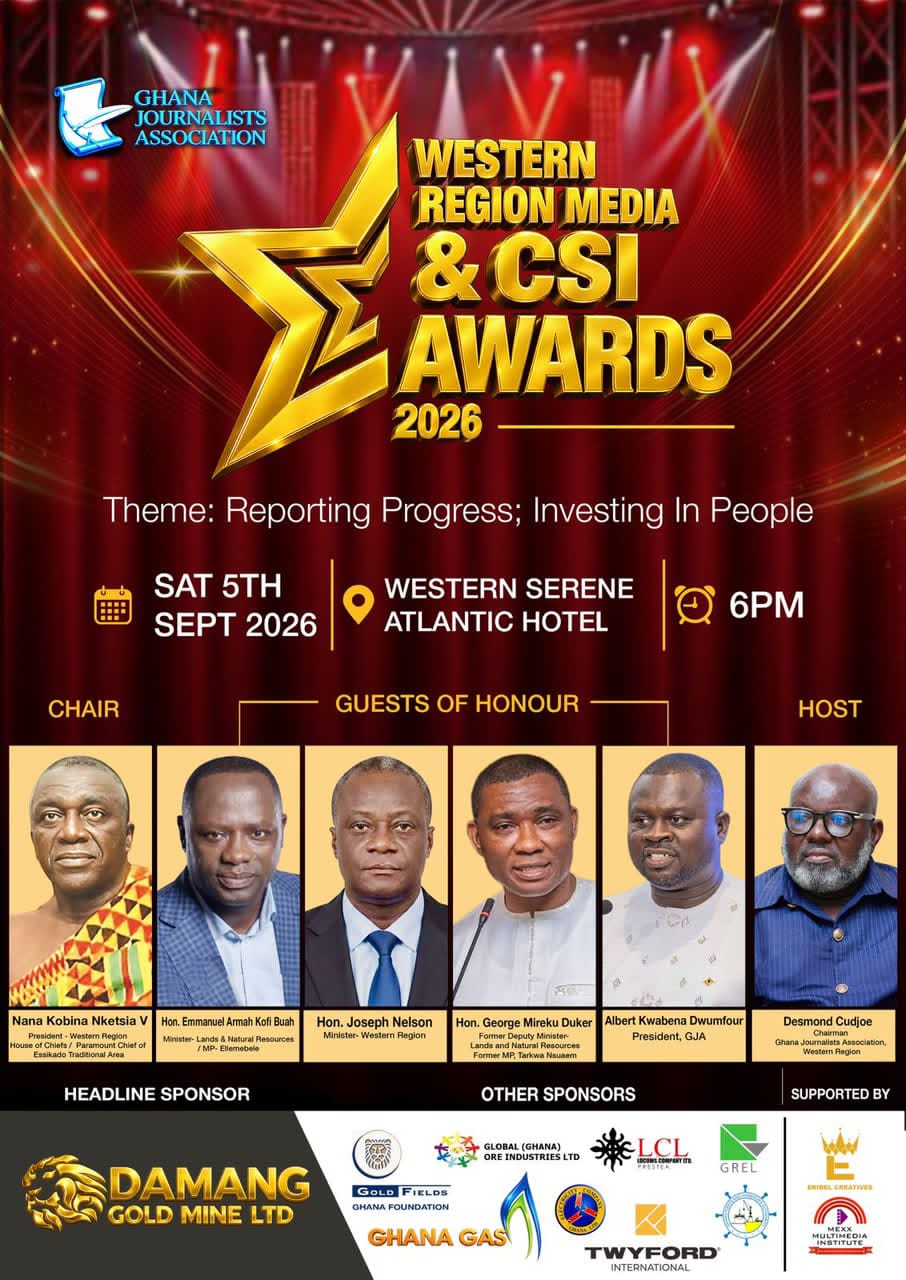
The Minister for Lands and Natural Resources, Hon. Emmanuel Armah Kofi-Buah, has charged the media to intensify its watchdog role by holding the government, mining companies, regulators and other stakeholders accountable for the management of Ghana’s natural resources.
Speaking at the 2026 Ghana Journalists Association (GJA) Awards in the Western Region, Mr. Kofi-Buah said the media had a critical responsibility to ensure that Ghana’s rich mineral and environmental resources were managed transparently and in the national interest.
He noted that Ghana’s gold, bauxite, manganese, lithium, forests, rivers and wetlands remained important contributors to national development through revenue generation, employment, foreign exchange earnings and community development. However, he stressed that natural resources could become either a blessing or a curse, depending on how they were governed and utilised.
According to the Minister, effective natural-resource governance requires transparency, accountability, responsible extraction, environmental protection, equitable benefit-sharing and strict enforcement of laws. He said his Ministry was committed to these principles and urged the media to closely monitor their implementation.
Mr. Kofi-Buah described the media as an indispensable institution in Ghana’s democratic system, saying journalists must go beyond simply reporting statements from the government, mining companies and civil society organisations. He urged them to investigate, question decisions and expose regulatory failures, environmental violations, conflicts of interest and misuse of public resources.
He also called on journalists to intensify their coverage of illegal mining, popularly known as galamsey, describing it as an environmental, economic, social, governance and national-security challenge. He said the destruction of forests and water bodies, degradation of farmlands and use of harmful chemicals could have serious consequences for agriculture, livelihoods, public health and the national economy.
The Minister, however, cautioned journalists against sensationalism, misinformation and politically motivated narratives. He stressed the need for reporters to verify allegations, seek responses from all relevant parties and clearly distinguish between facts, allegations and opinions, given the financial and reputational consequences of inaccurate reporting.
Mr. Kofi-Buah further urged media organisations to invest in specialised natural-resource journalism, noting that effective reporting on mining requires knowledge of geology, environmental science, economics, law, finance and public policy. He encouraged journalists to develop the capacity to analyse mining licences, contracts, environmental impact assessments, royalty payments, production figures and other technical data.
He also called on the media to give greater voice to communities affected by resource extraction, particularly chiefs, farmers, women and youth. He said their concerns over land acquisition, compensation, employment, environmental degradation and community development must form part of the national conversation on natural-resource governance.
The Lands Minister emphasised that the media should neither become an enemy of the government and industry nor serve as their mouthpiece, but should remain an independent watchdog and credible bridge between institutions and the public. He urged journalists to report achievements where they occur, question failures and expose violations wherever they are identified.
Mr. Kofi-Buah concluded by calling for a stronger partnership between the media and stakeholders in the natural-resource sector, founded on professionalism, independence, transparency and evidence-based journalism. He said the ultimate objective must be to ensure that Ghana’s natural resources serve the Ghanaian people today while being protected for future generations.
Read the official statement below!
SPEECH BY HON. EMMANUEL ARMAH KOFI-BUAH, MINISTER FOR LANDS AND NATURAL RESOURCES, AT GJA AWARDS IN WESTERN REGION 2026
Distinguished Guests,
Ladies and Gentlemen,
Members of the Media,
Colleagues and Friends,
It is a great honour to speak to you, particularly on the subject of natural-resource governance, which is central to Ghana’s development and, indeed, to the future of generations yet unborn.
Natural-resource governance in Ghana and the role of the media remain crucial.
Ghana is richly endowed with natural resources. From our gold, bauxite, manganese and lithium to our forests, rivers, wetlands and other ecological assets, these resources constitute an important foundation for our economic development.
For generations, natural resources have contributed significantly to government revenue, employment, foreign exchange earnings and the development of communities across the country.
However, the abundance of natural resources alone does not guarantee prosperity.
What determines whether natural resources become a blessing or a curse is how they are governed, managed and utilised, and our administration is delivering on that.
Good natural-resource governance requires transparency, accountability, responsible extraction, environmental protection, equitable benefit-sharing and the enforcement of laws and regulations.
This is what my Ministry is doing, and that is also where the media becomes indispensable in showcasing what we are doing.
The media is not merely a messenger that reports what the government, mining companies, civil society organisations or communities say.
The media is an important institution in our democratic system.
It has the responsibility to inform, educate, question, investigate and hold institutions and individuals accountable.
In the natural-resource sector, this responsibility becomes even more critical because decisions made today can have consequences for decades.
When a forest is destroyed, a river polluted or a mineral deposit extracted without proper regulation, the consequences are not limited to the immediate community.
They can affect agriculture, drinking water, public health, livelihoods and the national economy. Similarly, when natural resources are managed responsibly, the benefits can support infrastructure, education, healthcare, employment and sustainable economic growth.
The media, therefore, has a responsibility to bring these issues to the attention of the Ghanaian public.
One of the most important contributions the media can make is promoting transparency. Citizens have a right to know how Ghana’s natural resources are being managed, who receives mining licences, what obligations mining companies have, how much revenue is generated, and how communities benefit from resource extraction.
Investigative journalism can help uncover gaps between policy and implementation.
It can expose illegal activities, regulatory failures, conflicts of interest, environmental violations and the misuse of public resources.
But investigative journalism must be grounded in facts, evidence and professional ethics.
The media must also serve as a platform for public education. Natural-resource governance is often filled with technical language, legislation, geological concepts, financial arrangements and environmental terminology that ordinary citizens may find difficult to understand.
A responsible media must, therefore, translate complex issues into information that citizens can understand without distorting the facts.
For example, when discussing mining, journalists should help the public understand the difference between legal small-scale mining, illegal mining and large-scale mining.
They should explain the licensing process, environmental obligations, reclamation requirements and the responsibilities of mining companies, regulators, traditional authorities and local communities.
The media also has a crucial role in the fight against illegal mining, popularly known as galamsey.
Illegal mining is not simply an environmental issue. It is an economic, social, governance and national-security issue.
The destruction of forests and water bodies, the degradation of farmlands and the use of harmful chemicals can impose enormous costs on the country.
The media must, therefore, continue to shine a light on illegal mining activities and the networks that facilitate them. But while doing so, journalists must avoid sensationalism and ensure that their reports are based on verified information.
At the same time, the media must report not only the challenges but also the solutions and progress being made in natural-resource governance.
Responsible journalism should examine reclamation programmes, alternative livelihood initiatives, responsible mining practices, technological innovations, community participation and reforms designed to improve regulation.
This creates a more balanced national conversation and allows citizens to assess what is working and what needs improvement.
Another critical responsibility of the media is to give communities a voice.
Mining communities are often the first to experience both the benefits and the negative consequences of resource extraction.
Their concerns about land acquisition, compensation, employment, environmental degradation and social development must not be ignored.
The media can provide a platform for chiefs, farmers, youth, women, traditional authorities and community organisations to participate in national discussions about natural-resource management.
However, the relationship between the media and the natural-resource sector must be based on accuracy, independence and responsibility.
Journalists must resist misinformation, propaganda and politically motivated narratives.
A report about a mining company, government institution or community can have serious financial and reputational consequences.
Therefore, journalists must verify allegations, seek responses from all relevant parties and distinguish clearly between facts, allegations and opinions.
The media must also invest in specialised journalism.
Natural-resource reporting requires knowledge of mining, geology, environmental science, economics, law, finance and public policy. Ghana, therefore, needs more journalists who specialise in extractive-sector reporting and can interrogate budgets, contracts, environmental impact assessments, production figures, royalty payments and other technical information.
Editors and media organisations should support journalists with training and resources to undertake this work.
The media can also contribute significantly through data journalism. Ghana generates enormous amounts of information about mining licences, production, royalties, exports, environmental compliance and public revenues.
Journalists can use this data to identify trends, inconsistencies and areas requiring further investigation.
Beyond reporting, the media can help build a culture in which citizens understand that natural resources belong to the people of Ghana and must be managed in the national interest.
This requires a shift from reporting natural resources only when there is a crisis.
Natural-resource governance should become a continuous subject of public-interest journalism.
Ladies and Gentlemen,
Government institutions, regulators, mining companies, traditional authorities, civil society organisations and the media all have different responsibilities, but they share one common objective: ensuring that Ghana’s natural resources contribute to sustainable national development.
The media must, therefore, not see itself as an enemy of the government or industry. Neither should it become a mouthpiece for them. Its role is to remain an independent watchdog and credible bridge between institutions and the public.
Where government succeeds, the media should report it. Where government fails, the media should question it. Where mining companies operate responsibly, that should be acknowledged. Where they violate the law or environmental standards, the public deserves to know.
Ultimately, the goal is not to attack or defend any particular institution. The goal is to protect the public interest.
As Ghana moves towards greater value addition, responsible mining, environmental restoration and stronger natural-resource governance, the media must remain at the centre of the national conversation.
Let us use journalism to promote transparency rather than suspicion, evidence rather than rumours, accountability rather than impunity, and sustainable development rather than short-term exploitation.
Let us tell the stories of the people whose livelihoods depend on our forests, rivers and mineral resources.
Let us investigate the systems that govern these resources.
Let us educate citizens about their rights and responsibilities. And let us hold every actor—government, companies, regulators, traditional authorities and individuals—to the same standard of accountability.
The quality of Ghana’s natural-resource governance will ultimately determine whether our resources become a lasting foundation for prosperity or a burden for future generations.
The media has a powerful role in determining which path we take.
Let us, therefore, build a stronger partnership between the media and all stakeholders in the natural-resource sector—one founded on professionalism, independence, transparency, facts and the shared conviction that Ghana’s natural resources must serve the Ghanaian people, today and tomorrow.
Thank you for your attention.
